
The Authority Set
One photo of you. Ten rooms you have never been in. And a number that proves the man in the picture is still you.
The viral version of this is a prompt: upload a selfie, paste a paragraph, get a podcast-studio portrait, post it forever. The prompt is the easy half, and it is already free. The half that decides whether you can actually use the picture is what happens either side of it — whether you had the right to make it, which room your business should be standing in, and whether the face that came out is measurably the face that went in.
A better-looking stranger is worth nothing
Image models beautify by default. They smooth the skin, slim the jaw, take five years off, and hand back someone who reads as you-ish at thumbnail size. That is fine for a mood board and fatal for a personal brand, because the entire point of putting your face on the content is that people recognise it — on the page, in the DMs, and then in the room. If your posts show a slightly different person every week, you are spending money to look inconsistent.
The router
Type what the business actually is. This is the production router — the same registry, the same weights, the same tie-breaks — scoring all ten environments against your own words.
Scoring: an exact niche match is worth 3 points, a multi-word signal 2, a single keyword 1.5, and a loose description overlap 0.5 — then ties break alphabetically so the same input always returns the same set. No model call, no randomness, no server.
The clause nobody is copying
The prompts circulating are all environment: the lens, the lighting, the mood. Environment is the part the model is already good at. Everything below is the part that keeps you in the frame, and it exists because of what we measured, not because it sounded good.
Honest result: the anti-retouch clause helped, but it did not solve it. On the beautifying model it improved only 2 of the 4 renders. What solved it was changing the model — see the receipts below. Prompt wording is a weak lever compared to picking an engine that does not quietly retouch people.
Three measurements, because there are three ways to fail
| Leg | Points | What only this leg catches |
|---|---|---|
| Face-embedding similarity | 60 | A different human. Geometry is compared as a vector, not by eye — this is the leg that cannot be charmed by a flattering photo. |
| Vision adjudication | 25 | Technically the same face, visibly wrong: the jaw redrawn, an ear melted, a hand with a thumb in the wrong place. |
| Skin detail retention | 15 | The airbrush the other two forgive. Pores, lines and stubble are high-frequency energy; a beauty filter deletes them while keeping the geometry intact. |
Hard caps, not soft advice: an unmeasurable face caps the score at 60, a below-threshold similarity at 55, a "that is a different person" verdict at 45, and a smoothed face at 80 however good the rest looks. 85 and above is LOCKED and may ship. 65–84 is DRIFT. Below 65 is BROKEN. A leg that cannot be measured returns UNSCORED and caps the score — it never invents a number to fill the gap.
The airbrush test
This is the third leg of the real gate, running locally on canvas: it measures how much skin detail an AI portrait kept compared with the original photograph. Drop your own before-and-after, or load one of ours.
Same maths as production — YCrCb skin mask, high-pass against a sigma-2 blur, RMS energy over skin pixels, ratio capped at 2.0, bands at 0.70 and 0.45. One honest difference: the production gate measures the face box a detector found, and a browser has no face detector, so this crops the middle of the frame where a portrait's face lives. Verified against the Python reference on the same crop rule on 2026-08-28: 6 pairs run through both the Python engine and the browser port on the same crop rule — largest disagreement 0.006 on a 0 to 2 scale, identical band on every pair.
Six rooms from one selfie
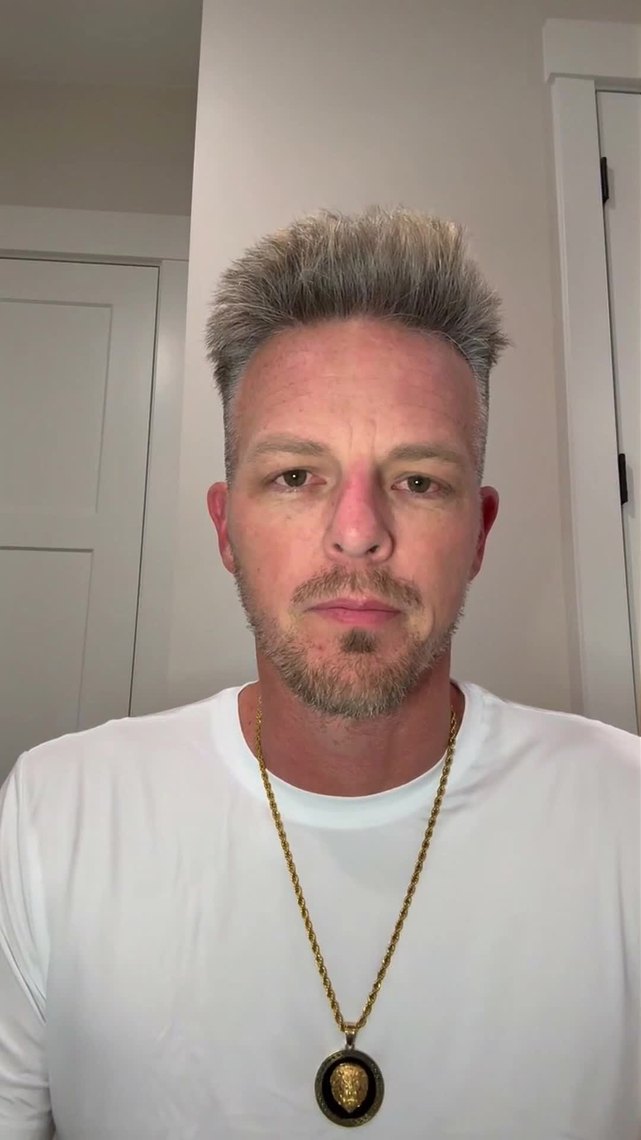
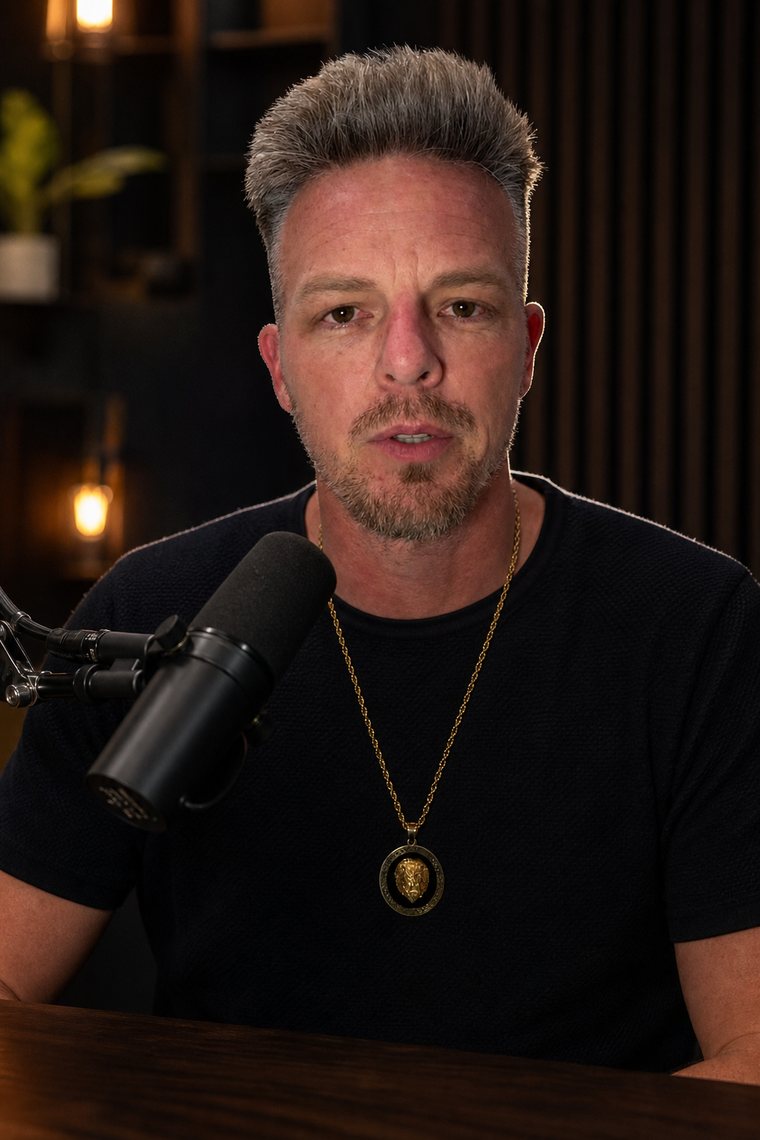
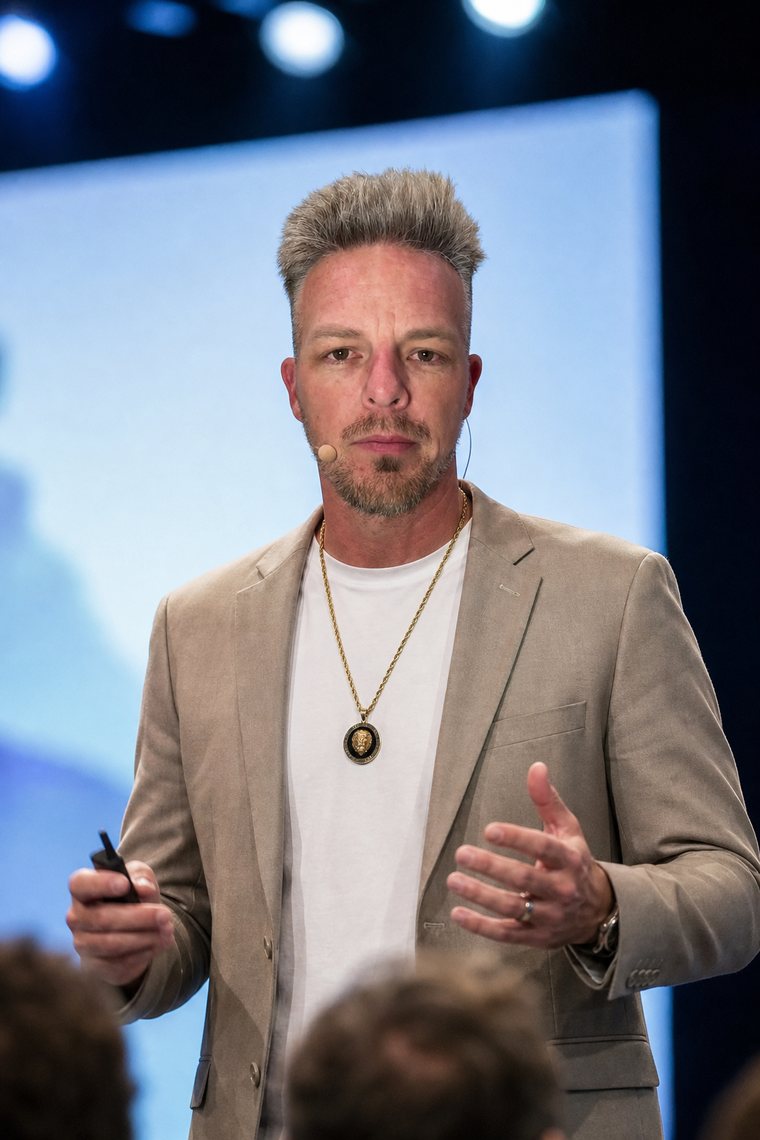
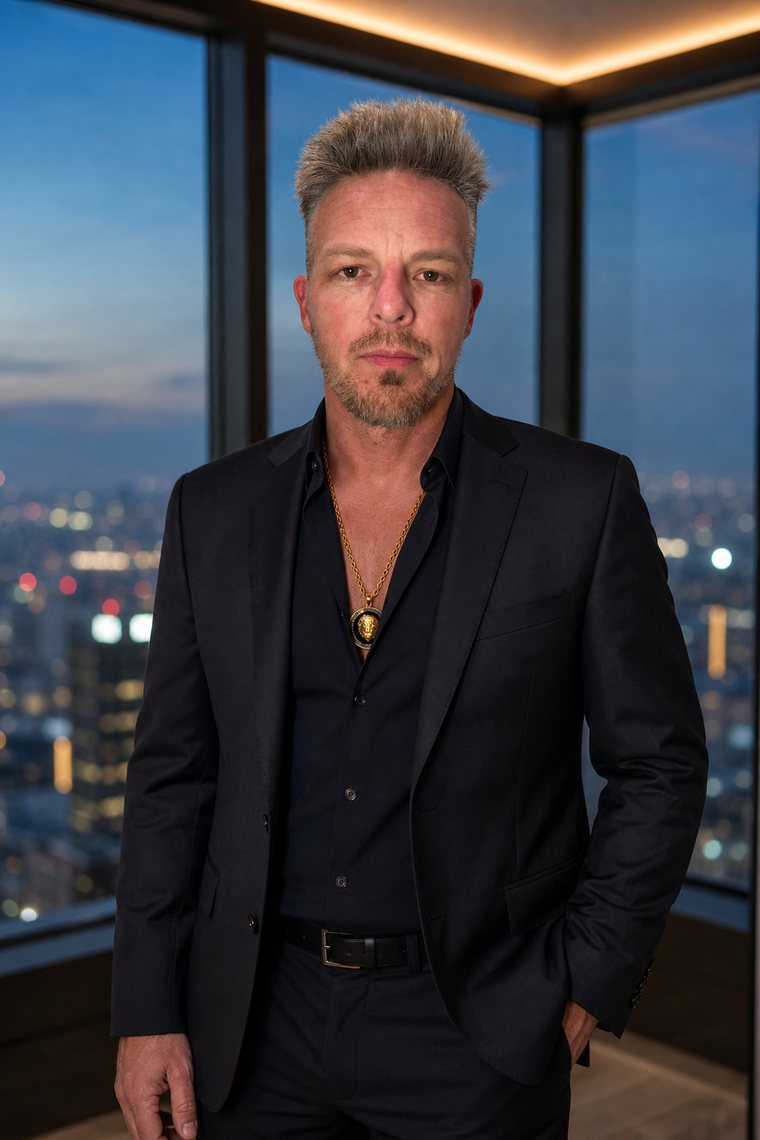
Every frame below came out of a single phone photograph on 2026-08-28, under a real consent record (self-granted, 2026-08-01, unrestricted scope, not revoked). The scores are the gate's own, printed whether they flatter us or not.

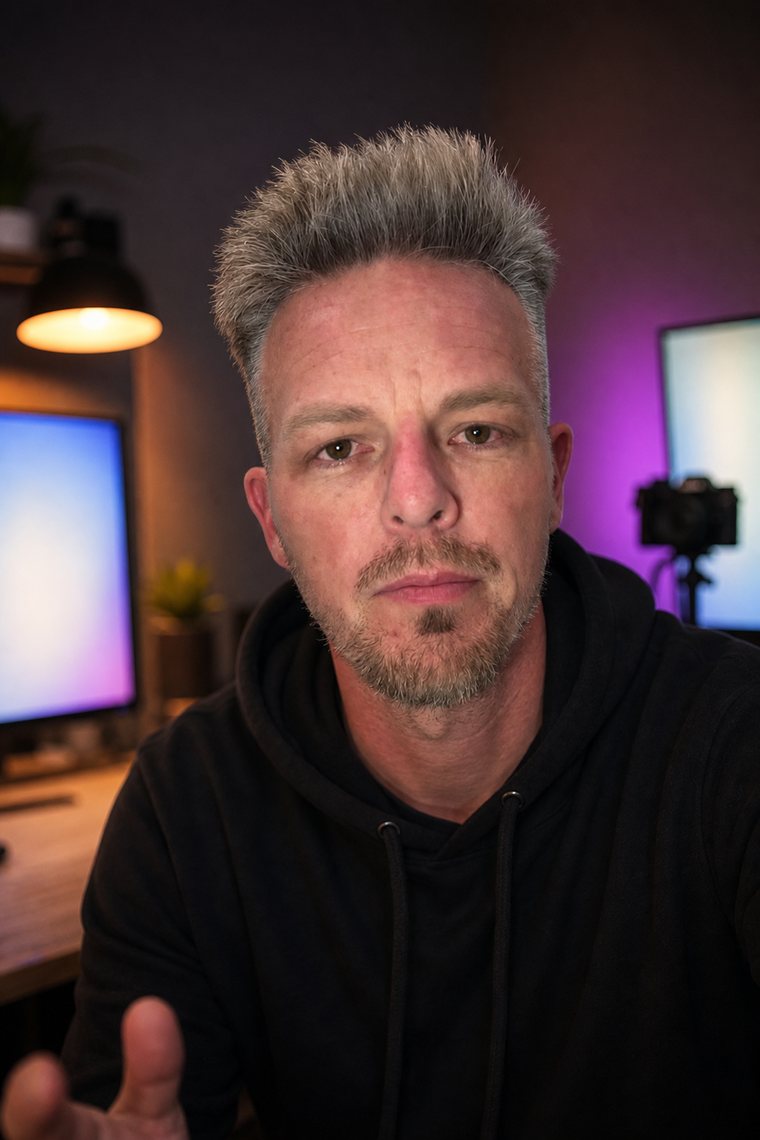
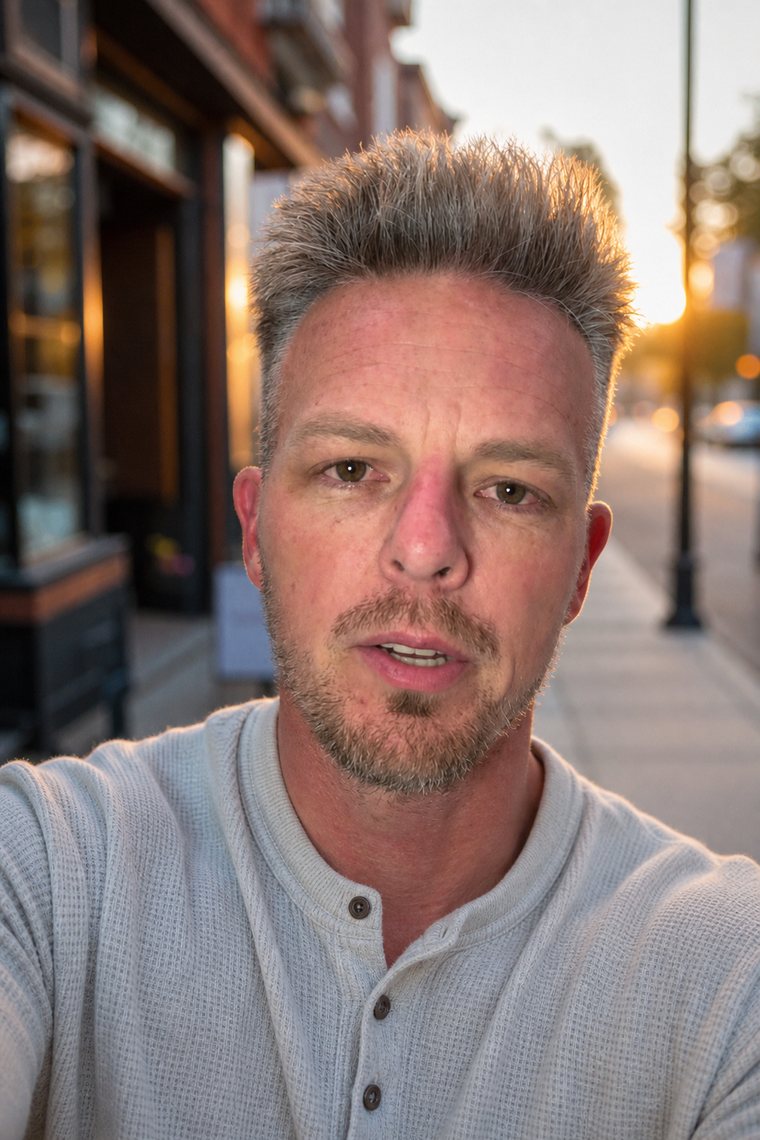
| Set | Score | Verdict | Similarity | Skin detail | Vision verdict |
|---|---|---|---|---|---|
| /podcast Podcast Authority | 93 | LOCKED | 0.938 | 1.334 NATURAL | DRIFT · flagged beautified |
| /keynote Stage Authority | 100 | LOCKED | 0.944 | 1.182 NATURAL | LOCKED · flagged beautified |
| /newsdesk Broadcast Desk | 93 | LOCKED | 0.95 | 1.256 NATURAL | DRIFT · flagged beautified |
| /boardroom Executive Corner | 93 | LOCKED | 0.961 | 1.088 NATURAL | DRIFT · flagged beautified |
| /desk Creator Desk | 100 | LOCKED | 0.961 | 1.146 NATURAL | LOCKED · flagged beautified |
| /street Walk & Talk | 93 | LOCKED | 0.944 | 1.326 NATURAL | DRIFT · flagged beautified |
6 of 6 frames cleared the gate on the identity-preserving model, with similarity between 0.938 and 0.961 against a source photograph — higher than two real photographs of the same man score against each other (0.667 and 0.755). Skin detail came back above 1.0 on every frame, meaning the renders carry more visible skin detail than the compressed source file: the opposite of the airbrush failure. The vision leg still flags a light beautification on all six and says so in the table — it is describing a real effect that is small enough to stay inside the band, which is why judgement is a 25-point leg and not a veto. Costs about four hundredths of a cent per frame to adjudicate.
The measurement we had to throw away
We already owned a face-fidelity score for talking-head video, and the obvious move was to reuse it here. It does not work across a scene change, and the only way to know that was to test it against a stranger. Same score, run on four renders of the real subject and three frames of a completely different man:
| Frame | Truth | Old score |
|---|---|---|
| Subject render — podcast | same man | 13.0 |
| Subject render — keynote | same man | 19.6 |
| Subject render — newsdesk | same man | 30.3 |
| Subject render — boardroom | same man | 48.3 |
| Stranger, frame A | DIFFERENT man | 33.6 |
| Stranger, frame B | DIFFERENT man | 36.0 |
| Stranger, frame C | DIFFERENT man | 36.5 |
The true positives scored lower than the impostor. There is no threshold you can draw through that table, which means anything gated on it would have been gated on nothing. The replacement was calibrated against the same controls before it was trusted with a client's face:
| Pair | Similarity | What it tells us |
|---|---|---|
| Photograph vs a different human (3 pairs) | -0.11 to -0.07 | The floor. A stranger scores below zero, nowhere near the threshold. |
| Two real photographs of the same human | 0.667 / 0.755 | The honest ceiling: this is what a genuine same-person pair looks like. |
| Our renders on the beautifying model | 0.705 - 0.767 | Passes as the same man, and the vision leg flagged all four as beautified. |
| Our renders on the identity-preserving model | 0.938 - 0.961 | Above the real-photograph control. This is why model choice beats prompt wording. |
The gap between the highest stranger and the lowest true positive is about 0.78, so the thresholds sit in empty space with room on both sides rather than being tuned to make our own output look good. Locked at 0.55, drift at 0.40.
The point is not the portrait
A locked still is the cheapest thing to hand to a talking-head engine — you get a spokesperson video without a camera, a light, or a good hair day, and the person in it is verifiably the client. A set of ten covers a quarter of posting: the same human, credibly, in the rooms his customers associate with authority, on a schedule no filming day can match. The gate is what makes that safe to automate. Without it, "post daily without filming" means "publish a stranger with your name on him, unattended, at scale."
Straight answers
Is this just a prompt I could get for free?
The prompt is free and we are not pretending otherwise — the reel that started this gives it away for a comment. What is not free is knowing whether the picture it produced is usable. Ours refuses to render without a likeness record, picks the environment from your business rather than the trend, and measures the output three ways before you ever see it. The prompt is about ten percent of the work and one hundred percent of what gets posted about.
What actually goes wrong with AI portraits of real people?
They get better looking. The model smooths the skin, sharpens the jaw, removes a few years, and returns someone who reads as you at thumbnail size and as a stranger in person. It passes a glance, which is why it ships. Then the client's audience meets a face that does not match the content and the trust the content was buying quietly leaks out.
How do you prove the person survived?
Three independent measurements. A face embedding compares the geometry as a vector, so it cannot be charmed by a flattering photo. A vision model adjudicates the pair and says plainly whether it is the same person and what changed. A texture measurement checks how much real skin detail is left, because an airbrush keeps the geometry perfectly and deletes the human. Any one of them can cap the score on its own.
Which room does my business get?
Whichever one your customers already associate with authority in your category, which is usually not the one going around on social. A contractor is more credible at the truck than behind a podcast mic; a provider is more credible in the treatment room. You can run the router on this page and see the reasoning and the score for all ten.
Can you do this with a photo of someone who has not agreed?
No. The pipeline stops at a consent gate before anything renders: who granted the likeness, when, for what use, and whether it has been revoked. There is no override for a client who wants a competitor's face, a celebrity, or an employee who has not been asked. Every delivered frame carries the record it was made under.
Does it work from an ordinary phone selfie?
Yes — that is the whole point, and the receipts on this page came from one. What matters is that the face is lit, in focus and unobstructed. A dark, motion-blurred or heavily filtered source gives the model less identity to hold on to, and the gate will tell you that in a number instead of letting you find out in the comments.
What happens to the frames that fail?
They are ledgered and never delivered. A frame between the bands is DRIFT and gets re-rendered; below that it is BROKEN. Nothing that failed can be handed to the talking-head engine or posted to a client account — a drifted still becomes a drifted video thirty times a second.
Want your ten rooms?
Send one photo. You get the set back scored, and the ones that did not pass, you never see — because they never should have existed.
We only build a set for someone who can grant the likeness themselves. We do not render other people's faces on request.